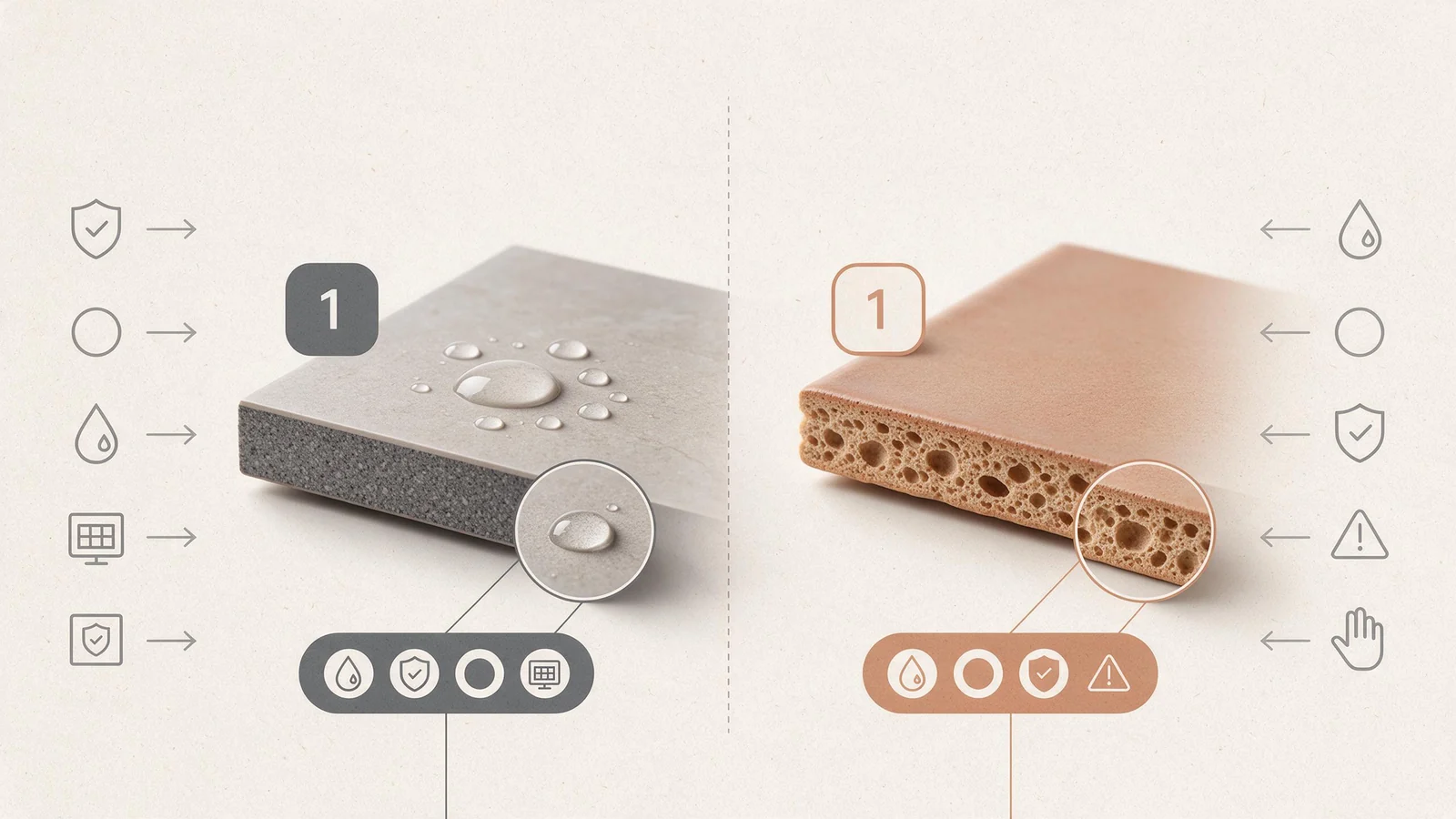
The question of porcelain vs ceramic tiles comes up in almost every project enquiry we handle, and the answer is less about marketing labels than about one measurable property: how much water a tile body absorbs. That single figure decides where a tile can be used, how it behaves over time, and which standard it falls under. This guide explains the difference between porcelain and ceramic tiles in plain terms, using the same industry definitions that buyers, specifiers and customs inspectors work with.
What Actually Separates Porcelain from Ceramic
Both porcelain and ceramic tiles are made from clay, shaped and then fired. The practical difference sits in the body density and the water absorption rate that follows from it. Denser bodies absorb less water. Less water absorption generally means a tighter, harder tile that resists staining and frost damage better than a more porous one.
The trade uses the word porcelain loosely. The standards do not. ISO 13006, the international standard for ceramic tiles, does not use the word porcelain at all. It groups tiles by shaping method, A for extruded and B for dry-pressed, and then by water absorption: Group I covers Eb of 3 percent or less, split into Ia at 0.5 percent or below and Ib between 0.5 and 3 percent; Group IIa covers 3 to 6 percent; Group IIb covers 6 to 10 percent; Group III covers above 10 percent. The tiles the trade calls porcelain correspond to class BIa, dry-pressed with water absorption of 0.5 percent or below. The groups describe the product, not its intended use, so a low-absorption tile is not automatically the right choice for every room.
In North America, ANSI A137.1 defines porcelain tile as tile with water absorption of 0.5 percent or less, measured by ASTM C373. That is a general industry definition, not a statement about any particular supplier's stock.
Where Ceramic Fits
Ceramic tiles sit in the higher absorption groups. They are typically lighter, easier to cut on site, and well suited to interior walls where foot traffic and standing water are not concerns. Glazed ceramic wall tiles give designers a wide colour and pattern range at a working cost, which is why they remain common in bathrooms, kitchens and feature walls.
Porcelain Tile Water Absorption in Practice
Water absorption drives real decisions. A tile with a low absorption rate holds up better in wet areas, in busy commercial floors and in outdoor paving, because water has less room to enter the body. A tile with higher absorption is more at home on a dry interior wall.
To make this concrete, one porcelain floor tile model, FTD-3030001, is tested to a water absorption below 0.5 percent, which corresponds to the ISO 13006 Group BIa range. That model is a 300 by 300 mm matte porcelain floor and wall tile with a modern look, listed for interior use in homes and hotels. It is one model among many, and its figures should not be read across the whole catalogue. For other tile categories we describe performance qualitatively rather than quoting a single number.
If you are comparing suppliers, ask for the water absorption figure and the test method behind it. A number without a method is hard to verify. Ceramic and porcelain tiles meet ISO 10545 standards, a 16-part series of test methods for ceramic tiles. Part 3, ISO 10545-3:2018, covers water absorption, apparent porosity, apparent relative density and bulk density. Knowing which part applies helps you read a report correctly.
Matching the Tile to the Space
Absorption is the first filter, but not the only one. Slip resistance, surface finish and format all matter, and the right combination changes from room to room.
Floors
For interior floors in homes, apartments and hotel rooms, a low-absorption porcelain tile gives a durable surface that handles daily cleaning. Matte finishes hide marks better in busy corridors. For outdoor areas, buyers in the UK often ask for porcelain paving, the local term for outdoor porcelain tiles and pavers. Outdoor porcelain tiles are made for patios, walkways and pool surrounds, where a dense body and a textured surface help underfoot. We do not claim frost resistance or weather cycling performance for our tiles, so if your project sits in a freeze-thaw climate, test the specific product you intend to buy.
Walls
Ceramic wall tiles remain the practical choice for bathrooms and kitchens, where the surface is rarely walked on and the priority is finish, colour and easy cleaning. Porcelain can also be used on walls, and larger formats reduce grout lines. Our ceramic wall tiles cover the bathroom and kitchen range, while porcelain tiles cover floor and wall applications in denser bodies.
Wet and Special Areas
Pool surrounds and waterline areas need tiles chosen for constant moisture. Pool tiles are a separate category for that reason. Terrazzo, vitrified and marble-look tiles each bring a distinct look, and porcelain slabs allow large-format surfaces for counters and feature walls. The right pick depends on the drawing, not on a single rule.
A Quick Comparison Table
| Point | Porcelain | Ceramic |
|---|---|---|
| Water absorption | Low, typically 0.5 percent or below for the BIa class | Higher, often above 3 percent |
| Body density | Denser, tighter body | Lighter body |
| Typical use | Floors, outdoor paving, heavy traffic areas | Interior walls, feature surfaces |
| Cutting on site | Harder, needs the right blade | Easier to cut and shape |
| Cost profile | Generally higher per square metre | Generally lower per square metre |
The table is a starting point. Project drawings, traffic levels and cleaning regimes decide the final specification.
How Winway Handles Tile Orders
Winway was established in 1997 in Foshan, China, and has over two decades of experience in design and building materials supply. We have a ceramic tile factory, a sanitary ware factory and a door and window factory, together with a complete design team and after-sales service team. Products have been delivered to more than 100 countries, serving over 100,000 customers worldwide, with a strong focus on the African market.
For tile buyers, the process is straightforward. Send your drawings, tile schedule or product list, and we will come back with a detailed quotation within 24 hours and 2-3 design options for your approval, free of charge. Once approved, a contract is signed and production begins in our Foshan facilities, with photos of the production process and finished products sent to you along the way.
We offer OEM and ODM services across most product lines, including custom tile sizes, surface textures and colour glazes. Custom orders typically require a higher MOQ and include a pre-production sample approval step before full manufacturing begins. We guarantee that the materials used in production are consistent with the approved samples.
Samples are free of charge across all product categories including tiles. You only pay the international shipping cost, which lets you check colour, surface texture and finish before committing to a bulk order.
Packing, Shipping and Quality Control
Tiles are packed in reinforced export cartons with foam padding and corner guards, and FCL orders are palletized for stability during ocean freight. Every order goes through documented quality control before shipping, and a quality inspection team follows up with spot checks during production, combining computer and manual review. During loading, the logistics team counts the goods again and takes photos and videos. Third-party inspection reports and factory audit documentation are available on request for any product line.
We support FOB (Foshan or Guangzhou port), CIF and EXW, and door-to-door delivery is available for some countries. Sea freight typically takes 15-45 days depending on your destination port, and air freight for samples or urgent small orders arrives in 5-10 business days. Tiles, bathroom fixtures, doors, flooring, kitchen cabinets and hardware can be consolidated into a single FCL shipment from our Foshan warehouse, which consolidates your orders into one shipment from our Foshan warehouse.
Our project portfolio includes villas, apartments, hotels, a hospital, a spa and a bar in Zambia, Tanzania, Uganda, Senegal, the Republic of the Congo, Burkina Faso, Kenya and Ethiopia. If you are weighing porcelain vs ceramic tiles for a project in any of these markets, or somewhere else, send the drawings and we will match the right category to each space.
Common Questions from Buyers
Is porcelain always better than ceramic?
No. Porcelain wins on floors, wet areas and outdoor paving because of its low water absorption. Ceramic wins on interior walls where cost, weight and easy cutting matter more than density. The right answer depends on where the tile goes, not on which word sounds stronger.
How do I check a water absorption claim?
Ask for the figure and the test method. ISO 10545-3:2018 is the relevant part of the ISO 10545 series for water absorption. A number without a method is difficult to verify, and a single model's figure should not be applied to an entire catalogue.
Can I mix tile categories in one container?
Yes. Tiles, bathroom fixtures, doors, flooring, kitchen cabinets and hardware can be consolidated into a single FCL shipment from our Foshan warehouse. This is one of the practical advantages of buying from a supplier with several product lines under one roof.